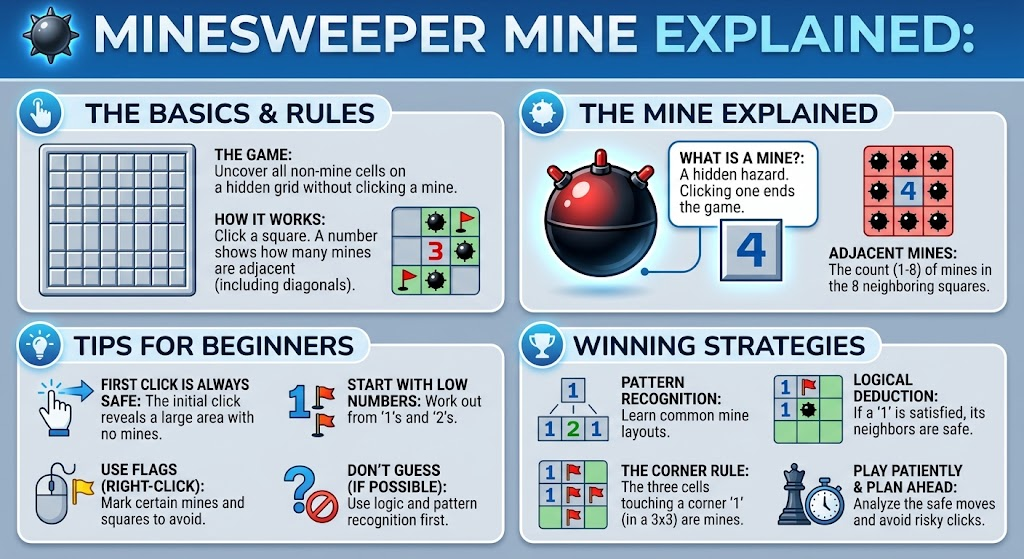
Minesweeper Mine Explained: Tips, Rules, and Winning Strategies
A minesweeper mine is the hidden danger that makes the classic puzzle game exciting. Your goal is simple: uncover safe squares while avoiding every hidden mine. The game does not ask you to guess blindly. Instead, numbers around each opened square provide useful clues. With careful thinking, you can use those clues to identify dangerous spaces and safe moves.
Minesweeper looks easy when you first see the board. Yet a large board can quickly become challenging. One wrong click may end the game. That is why learning how mines work can improve your results. You can also learn how flags, numbers, empty spaces, and probability work together. This guide explains the rules in simple language. It also shares practical solving habits that can help beginners become more confident players.
Minesweeper Mine Profile
| Detail | Information |
| Game type | Logic and puzzle game |
| Main goal | Clear safe squares without opening mines |
| Main danger | Hidden mines |
| Main clue | Numbers on opened squares |
| Common action | Left-click to open a square |
| Common marking action | Right-click to place a flag |
| Key skill | Logical deduction |
| Helpful concept | Neighboring squares |
| Winning method | Identify mines and clear safe spaces |
| Best beginner habit | Read every nearby number |
| Difficulty | Changes with board size and mine count |
| Core challenge | Making safe decisions from limited clues |
What Is a Minesweeper Mine?
A minesweeper mine is a hidden square that ends the game when you open it. The mine is not usually visible before you make your move. You must study the clues around it instead. Every numbered square tells you how many mines touch that square. The nearby spaces can include mines, safe squares, or already opened areas.
For example, imagine a square showing the number one. That number means one mine exists among its neighboring covered squares. A number three means three nearby squares contain mines. The clue does not tell you exactly which square contains the mine. You must compare it with other numbers and nearby flags. This creates the main puzzle. You are solving a small logic problem with every move.
How Does a Minesweeper Mine Work?
A minesweeper mine follows a simple rule within the board. When you open a safe square, the game may reveal a number. That number counts the mines touching the square. Touching includes the eight possible spaces around it. This includes spaces above, below, beside, and diagonally next to the clue.
Suppose you open a square marked two. You then see three covered squares beside it. Two of those three spaces must contain mines. You cannot know which two immediately. However, another nearby number may provide the missing information. By combining clues, you can narrow down the choices. This is why experienced players do not focus on one number alone. They look at groups of numbers and compare their shared covered squares.
Why Are Numbers Important?
Numbers are the most important clues in Minesweeper. Each number gives information about nearby hidden mines. A zero means no mines touch that square. A one means one nearby mine exists. Higher numbers mean more mines are present around that location. These simple clues create the logic needed to solve the board.
A minesweeper mine becomes easier to find when several clues point toward the same area. Imagine a row containing the numbers one, two, and one. Covered squares sit beside all three numbers. The first clue may tell you one square is dangerous. The middle clue then adds another condition. The final clue can help confirm your conclusion. This process is called deduction. You are not simply reacting to the board. You are using information to reduce uncertainty before clicking.
How to Identify a Hidden Mine
Finding a minesweeper mine starts with a basic comparison. Look at an opened number and count its covered neighbors. Then count how many mines have already been marked around that number. If the number still needs one mine and only one covered square remains, that square must contain a mine.
This rule is one of the easiest patterns for beginners. Imagine a number two with two covered neighbors. If neither neighbor has been marked, both must be mines. You can flag both spaces before moving forward. Another useful pattern appears when a number already has enough flagged mines around it. Any other covered neighbors can then be safe to open. These small deductions become powerful when you repeat them across the board.
What Does a Flag Mean?
A flag is a visual marker for a suspected mine. In many versions, you place it by right-clicking a covered square. The flag does not remove the mine. Instead, it helps you remember which spaces you believe are dangerous. This can prevent accidental clicks during a complicated game.
A minesweeper mine should only be flagged when the clues support your decision. Beginners sometimes place flags randomly because a square looks suspicious. That habit can create confusion later. A better approach is to use flags as confirmed or strongly supported markers. Once you know that a square is a mine, marking it helps you solve nearby clues. Flags are therefore useful for memory, organization, and logical deduction.
What Happens When You Open a Mine?
Opening a minesweeper mine usually causes an immediate loss. The board may reveal the mines so you can see what happened. This sudden ending is why every click should be considered carefully. However, losing is also a useful learning experience. You can review the surrounding clues and understand where your reasoning failed.
Sometimes the mistake comes from reading only one number. Other times, a player may forget that diagonal squares count as neighbors. Another common problem is treating a guess as a certain answer. Good Minesweeper play separates known facts from uncertain possibilities. If the board gives no logical answer, you may eventually need to make a probability-based choice. Recognizing that situation is an important skill.
Minesweeper Mine Patterns Beginners Should Learn
Several common patterns make a minesweeper mine easier to identify. One basic pattern occurs when a number equals the number of covered squares around it. In that situation, every covered square touching the clue must be a mine. Another pattern appears when a clue already has the required number of flagged mines. Its remaining covered neighbors are then safe.
A simple example is a number one beside one covered square and several already cleared spaces. If that covered square is the only remaining neighbor, it must contain the mine. Another useful pattern involves two nearby numbers sharing the same covered squares. Comparing those numbers can show which additional square contains a mine. You do not need to memorize dozens of patterns at first. Learn the basic rules, then let more advanced patterns develop naturally through practice.
How to Avoid Accidentally Clicking a Mine
Avoiding a minesweeper mine requires patience more than speed. Before opening a covered square, check every nearby number that can provide information. Look horizontally, vertically, and diagonally. A clue may appear several spaces away from where you are currently working, yet still affect your decision.
It also helps to separate safe moves from uncertain moves. If you can prove that a square is safe, open it. If you can prove that another square is a mine, mark it. Leave uncertain areas alone until new information appears. This approach reduces unnecessary risks. Fast players may finish quickly, but careful players often achieve better consistency. Once your logic becomes stronger, your speed will naturally improve.
Beginner Strategy for Solving Minesweeper
A good beginner strategy starts with the easiest clues. Open safe areas and look for numbers with very few covered neighbors. These clues often provide the strongest information. Mark confirmed mines and then use those flags to solve nearby numbers. Continue moving from one logical deduction to another.
When you face a difficult section, avoid clicking randomly right away. First check whether another part of the board can reveal useful information. Opening a safe square elsewhere may expose new numbers and help solve the harder area later. A minesweeper mine is rarely solved by one clue alone on a difficult board. Strong play comes from connecting several clues and updating your understanding after every safe move.
How Empty Squares Help You
Empty squares are extremely useful because they contain no nearby mines. When you uncover a zero, many versions automatically open nearby safe spaces. This can reveal a large section of the board. The newly opened numbers then give you more clues for identifying dangerous areas.
A minesweeper mine cannot touch a zero square. This fact can immediately eliminate several possible locations. If a covered square sits directly beside a zero, it is safe. Empty areas can therefore act as strong starting points. They also reduce the number of unknown spaces you must study. When a board gives you a large open section, take time to examine its edges carefully. Those boundaries often contain the clues you need next.
Can You Always Find a Mine Through Logic?
Not every Minesweeper position gives you a guaranteed logical move. Some boards eventually create situations where two or more covered squares appear equally possible. In those moments, you may need to compare probabilities. This is one reason the game can feel different from a normal puzzle with one clear solution path.
The best players still avoid guessing too early. First, search the entire board for another certain move. A safe deduction in one corner can sometimes unlock a difficult section somewhere else. If no guaranteed move exists, choose the option with the better odds. Keep in mind that different game versions may generate boards differently. Some versions also use rules designed to make the first move safe.
Common Mistakes Players Make
One common mistake is clicking too quickly. Speed can be exciting, but rushing often causes simple errors. Players may overlook a diagonal neighbor or forget a flag they placed earlier. Another mistake is assuming that every covered square near a high number is dangerous. The number only tells you the total number of mines touching that clue.
Another issue is using flags without proof. A wrong flag can make later clues appear impossible. When your board stops making sense, review your earlier assumptions. You may have marked a safe square as a mine. Treat each flag as a logical claim rather than a random guess. This habit makes your board easier to understand and helps you recover from mistakes.
Advanced Thinking for Better Results
Once you understand the basic rules, you can start comparing groups of clues. Look for numbers that share the same covered squares. If one clue needs one mine among two spaces, while another clue includes those same spaces plus one extra square, their difference can reveal useful information.
This type of reasoning makes the minesweeper mine problem much more interesting. You are no longer solving each number separately. Instead, you are comparing relationships across the board. Keep track of what you know and what remains uncertain. You can even mentally divide the board into smaller sections. Solving one section may provide information that helps with another section. With practice, these relationships become easier to recognize.
Minesweeper Mine and Probability
Probability becomes important when pure deduction cannot identify a safe move. Suppose two covered squares have exactly the same clues around them. If one must contain a mine, both may have an equal chance. In that situation, clicking either square could produce the same risk.
However, probability can become more useful when different groups have different numbers of unknown spaces. A square connected to several possible mine combinations may be riskier than another square with fewer possibilities. Advanced players can calculate these chances more carefully. Beginners do not need complex mathematics. Simply remember one rule: do not guess until you have checked every available logical move.
How to Practice and Improve
The easiest way to improve is to play regularly and review your decisions. Do not focus only on whether you win. Pay attention to why each move was safe or dangerous. When you lose, look at the clues around the mine and identify the point where your reasoning changed.
You can also practice one skill at a time. First, learn to recognize numbers and neighboring squares. Next, practice identifying confirmed mines. Then work on finding safe squares from completed clues. Later, try comparing multiple numbers at once. This gradual method makes the game less frustrating. Over time, you will start recognizing familiar board shapes without needing to calculate every detail from scratch.
Why Minesweeper Remains Popular
Minesweeper remains appealing because its rules are easy to understand but difficult to master. You can learn the basic idea within minutes. Yet larger boards can demand careful attention and strong reasoning. Every click can change the information available to you.
The minesweeper mine also creates a clear sense of tension. You know that danger may be hidden behind any covered square. At the same time, the numbers give you enough information to make smart decisions. This combination makes the game satisfying for casual players and puzzle fans. It rewards patience, pattern recognition, memory, and logical thinking without requiring complicated controls.
Is Minesweeper Good for Logical Thinking?
Minesweeper can provide useful practice with logical reasoning. The game asks you to interpret clues, compare possibilities, and make decisions based on available evidence. These are simple thinking skills that appear in many everyday problems.
The game also teaches players to manage uncertainty. Sometimes you know an answer with complete confidence. Sometimes you only have several possible choices. Learning to tell the difference is valuable. A minesweeper mine is therefore more than a simple obstacle. It becomes part of a puzzle that encourages careful observation. The game can be relaxing when played casually, while challenging boards can provide a stronger mental workout.
Practical Tips for Safer Moves
When you are unsure about a move, pause for a few seconds. Check all eight neighboring positions around the relevant clue. Count existing flags and compare them with the number shown. Then ask whether the remaining covered squares must be safe or dangerous.
Another useful habit is to keep your board organized. Mark confirmed mines consistently. Avoid placing temporary flags unless you clearly remember they are uncertain. If you use a flag incorrectly, later clues may lead you toward the wrong conclusion. A minesweeper mine becomes easier to manage when every mark on the board has a clear reason behind it.
Final Thoughts on Minesweeper Mine
Understanding a minesweeper mine is the key to becoming more confident at the game. The goal is not simply to click quickly. It is to read clues, compare nearby squares, and make decisions based on evidence. Numbers tell you how many mines are nearby. Flags help you remember dangerous locations. Empty squares provide safe information and often open new parts of the board.
The best improvement comes from steady practice. Start with simple deductions and avoid unnecessary guesses. When you make a mistake, study the clue that you missed. Over time, common patterns will become easier to recognize. Whether you play casually or chase faster completion times, better logic will make each board more enjoyable. Try these strategies during your next game and see how much more confidently you can handle hidden mines.
Frequently Asked Questions
1. What is a Minesweeper mine?
A minesweeper mine is a hidden dangerous square on a Minesweeper board. Opening that square normally ends the game..
2. How do I know where a mine is?
Look at an opened numbered square and count its covered neighbors. Then subtract any mines you have already confirmed around it.
3. What does a number mean in Minesweeper?
A number tells you how many mines are directly adjacent to that square. The count includes horizontal, vertical, and diagonal neighbors.
4. Should I flag every suspected mine?
You should flag a square when the clues provide a strong reason to believe it contains a mine. Random flags can cause confusion because an incorrect flag may make other clues misleading.
5. Can Minesweeper be solved without guessing?
Many board positions can be solved entirely through logic. However, some situations may leave several equally possible choices.
6. What is the best tip for Minesweeper beginners?
The best beginner tip is to slow down and read the clues carefully. Do not click simply because a square looks safe. Check the nearby numbers and count their covered neighbors.